Selling your home isn’t just about listing it; it’s about timing your entry into the market when buyers are most active and willing to pay a premium. Entering the market at the best time to sell your house can make a significant difference, as housing trends shift throughout the year based on demand, competition, and economic conditions.
When buyer activity peaks and inventory is limited, sellers are more likely to attract multiple offers, sell faster, and secure better prices. During slower periods, increased competition can lead to longer selling times and more negotiation.
This guide will walk you through the key trends so you can better understand when to sell a house and maximize your return.
Connecticut Housing Market Trends 2026
Before deciding on when to sell your house in Connecticut, sellers must analyze certain factors. Here are some of the most important factors that affect the Connecticut housing market.
Home Prices and Demand Trends
Prices for houses in Connecticut are very strong in 2026, because of limited supply and high buyer demand across all counties. Sale prices for houses in Fairfield County remain strong as well, owing to its proximity to the city of New York and the availability of good transport links. Year-on-year house prices continue to increase in Connecticut at low to mid single-digit percentages, with no signs of skyrocketing in sight.
In terms of buyer demand characteristics, buyers in Connecticut have shown strong demand for suburban areas due to lot sizes and the diversity of property stock. Properties near Route 15, Route 25, and Metro-North Rail stations attract constant buyer attention year-round.
Inventory vs Buyer Demand
Inventory remains an identifying characteristic of the Connecticut real estate market in 2026. Since housing availability is below historical averages, there are more interested buyers than properties listed in several towns. In many cases, it is more advantageous for sellers to offer their properties during periods of high demand, they can expect to receive several offers with less price negotiations.
Cities like Trumbull, Shelton, and Monroe have shown higher absorption rates due to a shortage of listings relative to buyer interest.
Impact of Interest Rates
Mortgage rate fluctuations are one of the most powerful drivers of buyer behavior in any residential market. With just a minor reduction in interest rates, the number of potential buyers will increase, especially those with medium-priced homes. As seen in 2026, interest rate stability has helped maintain a steady buyer presence without relying on the spring season alone to generate competitive offers.
Best Time to Sell a House in Connecticut
Not all months are the same for sales. The price and demand in the market varies depending on the season.
Spring (March to June): Highest Demand and Pricing
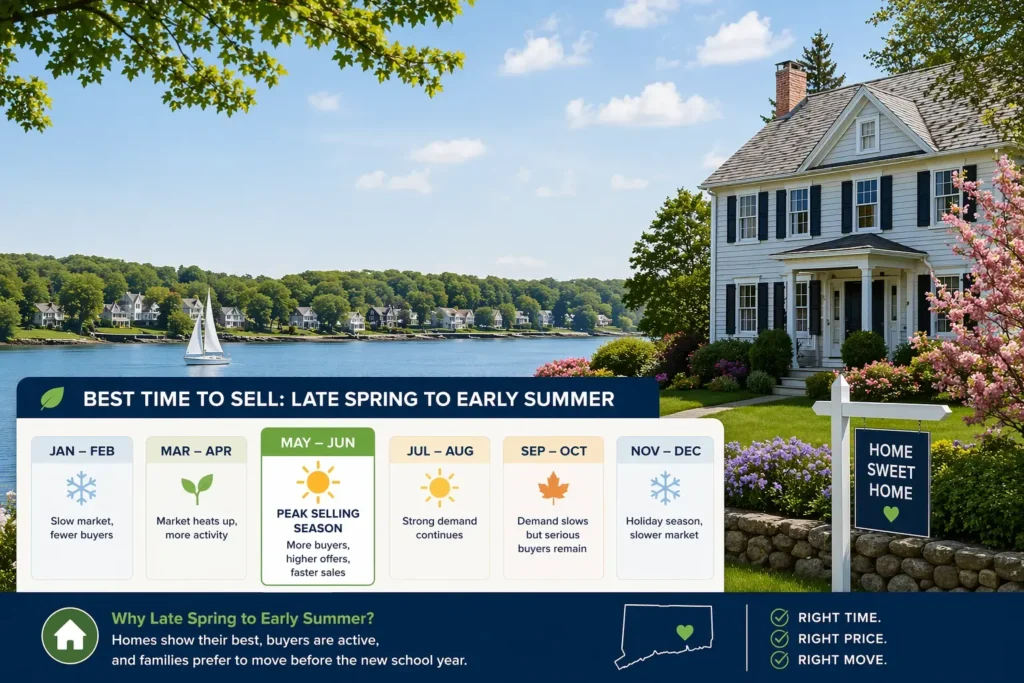
Spring is historically the best time to sell a house in Connecticut in terms of both buyer volume and achievable sale prices. From late March through June, listing activity surges alongside buyer urgency. Seasonal trends indicate that spring is consistently considered the ideal time to conduct residential sales. It is easy to organize viewings since the day lasts longer and the weather is great. The desire to buy one’s dream house before summer is very high.
April and May listings attract most attention. Individuals who can prepare their homes for sale in February and March will definitely benefit from these trends.
Summer (July to August): Stable Market Activity
However, the best season to sell your home in CT is not limited to June. There will be fewer buyers during the summer than in springtime, but the ones who buy homes in the summer will be determined and serious about purchasing their homes. The inventory will increase a bit because of spring listings that did not close.
Fall (September to October): Lower Competition Advantage
September and October present a second chance for Connecticut-based sellers that is often overlooked. There is an increase in buyer activity post-Labour Day, and the supply of homes is usually lower since many have already sold during the summer months. Studies indicate that fall housing markets tend to favor homes that are priced properly. A well-priced property listed in September can benefit from serious buyer demand with fewer competing listings.
Buyers in Connecticut in the fall season want to conclude transactions by the end of the year, for taxes and lease expiration dates. The sellers who have entered the market within this period, with their homes in good condition, are ready for sales.
Winter (November to January): Motivated Buyers
Winter is typically the quietest time in Connecticut’s real estate sector, with little activity from both buyers and sellers. However, buyers looking during this period are usually quite serious. Buyers who have moved for relocation reasons, those transferred from corporate offices, and buyers with time constraints, do not stop looking because of winter.
Read More: Which Towns Give the Best Long-Term Resale Value?
Best Time to Sell by Location in Connecticut
The best time to sell your property also depends on the specific submarket you are in, including areas like Fairfield County, Stamford, Norwalk, and the luxury segment.
Fairfield County Market Timing
Fairfield County is a little different from other cities in Connecticut because it is close to New York City, and its housing stock includes a variety of properties at different price levels. If you plan to Sell Home in Stamford, many people have moved from Manhattan and Brooklyn; therefore, they can provide an ongoing supply year-round instead of only in the spring season.
The beginning of the spring market in the towns of Fairfield County, like Westport, Darien, Weston, and Trumbull, usually begins a little earlier. The sellers in Fairfield County should list their properties by late February and early March if they want to get ahead of their competitors.
Stamford and Norwalk Trends
Both Stamford and Norwalk enjoy great commuter rail connectivity via Metro-North, and hence, buyers who work in New York regularly show up. This ensures that these markets are more active throughout the year than any inland communities in Connecticut. However, the best time to sell houses in Connecticut, specifically Stamford and Norwalk, is the spring season, even though the fall period is significantly higher than the other markets.
Those who want to list their homes around the Stamford and Norwalk train stations are advised to compare recent transactions with an agent to prepare a price.
Darien and Westport Luxury Segment
The luxury segment in Darien and Westport follows its own timing patterns. High-end properties typically require longer marketing periods regardless of season, and buyers at this price point are often less sensitive to mortgage rate fluctuations. The spring is considered the best time of year for sales, although summer sales in Darien and Westport can prove successful for relocated buyers from the coastal areas.
Is 2026 a Good Time to Sell a House in Connecticut?
Considering the present state of the real estate market, it is safe to say that the year 2026 is a favorable year to sell homes in Connecticut. Given the stability in market rates and the low level of inventory, these components create an opportunity for home sellers to negotiate effectively, especially when listing their homes amid high buyer interest.
Sellers who want to know if now is a good time to sell a house in Connecticut need to consider not only the current climate but also other aspects of their particular situations.
Should You Sell Now or Wait
There is no universal answer to whether you should list immediately or wait for a specific market shift. If the property is well-maintained and you can sell it for a fair price, the current Connecticut market offers a robust foundation. Risks associated with timing the reduction in interest rates and the highest price point may not be worth it, despite any potential benefits.
The best way forward would be to seek assistance of a professional real estate agent in Connecticut.
When Should You Sell Your House?
When selling a house, optimal time will vary depending on individual circumstances play a far greater role in your timing decision than mere months on a calendar.
Selling for Maximum Price
To get the best price, you must know the best time to list your house, which falls between April and the middle of May. This is the period with the most buyer competition, and houses in good shape receive offers that equal or exceed the list prices.
Selling for Speed
Even when the fastest possible closing is your main objective, spring is still your best bet, but selling in late summer and early fall will also do the trick. The surest way to ensure the home sells quickly is to price the property aggressively from the beginning.
Selling Due to Relocation
It may not be possible for relocating sellers to strategize based on the time of listing. Under such circumstances, preparation and pricing become much more important than the timing of the listing. Connecticut sees relocation buyer activity year-round, particularly in Fairfield County markets connected to the New York metropolitan area.
Selling Based on Financial Goals
Sellers motivated by financial goals such as accessing home equity for another purchase or investment should work through the numbers carefully with both a real estate professional and a financial advisor. The net proceeds of a sale depend not just on the sale price but on closing costs, agent commissions, and preparation expenses.
How to Sell Your House Faster in Connecticut
It’s possible to be both fast and economical. These are the three factors that will most effectively increase the speed of sales for your Connecticut house listing.
Pricing Strategy Based on Market Data
Accurate pricing from the start is the most powerful tool for a faster sale. Overpriced listings accumulate days on market, develop a stigma with buyers, and frequently sell for less than a correctly priced launch would have achieved. Your agent should provide a comparative market analysis based on recent closed sales within the past 90 days in your immediate area.
Home Presentation and Staging
Buyers’ decision-making process is influenced by their first impression of the house. Professionally staged and professionally photographed houses receive substantially more showing requests than those that have not been staged. There is no need for expensive staging to make your property attractive to potential buyers. Simple but cleaner settings can do the work.
Listing Visibility and Marketing
Maximum listing exposure across the multiple listing service, major real estate portals, and targeted digital channels shortens time on market. Professional photography is non-negotiable. Video walkthroughs and 3D tours have become standard expectations among buyers in the current market and can substantially increase inquiry rates.
Common Mistakes to Avoid When Selling
Even well-prepared sellers can undermine their own listing with a few preventable missteps. These are the three most common errors Connecticut sellers make, and how to avoid them.
Overpricing the Property
Overpricing is the most common and costly mistake Connecticut sellers make. The first two weeks of a listing generate the most buyer activity; if the price is too high during that window, you miss your best opportunity.
Ignoring Market Timing
Being on the market during an inappropriate period without a clear rationale can prolong your stay on the market. If you choose the right market timing, you can increase your chances of success by matching your listing period to the seasons when buyers are most interested. Otherwise, work on other controllable factors.
Weak Marketing Strategy
If your listing fails to appeal to potential buyers due to ineffective marketing, it will underperform despite its cost or quality. Make sure that your realtor has a written marketing strategy that incorporates listing in the MLS, high-quality photographs, online marketing, and contacting buyer’s agents representing buyers within your budget range.
Seller Costs in Connecticut
Knowing how much money you will get will help you to be better informed about how much to charge and market your home. The following is an estimate of the different types of costs that will need to be accounted for.
Agent Commission and Closing Costs
In Connecticut, any seller selling their home spend between six and eight percent of the purchase price in terms of overall closing costs, such as agent commission, transfer taxes, attorney fees, and prorated property taxes. Transfer tax, attorney’s fee, and prorated taxes are among the closing costs involved. The actual costs vary based on the municipality where the home is located, the price, and the agreed-upon terms.
Preparation and Repair Costs
The renovations and updates you intend to carry out before selling your property may be minor or major in scale. This depends on the condition of your home. Ensure that whatever improvements you make impact how your house will be viewed. Your agent can help determine what improvements will suit your market needs.
Connect with a Connecticut Real Estate Expert
While selling your home in Connecticut, understand how timing, pricing, and preparation come together. The 2026 market shows that strong demand and limited inventory are creating opportunities throughout the year. So, enter the market prepared, with the right pricing strategy, strong presentation, and a clear understanding of your goals.
If you’re thinking about selling, understand where you stand in today’s market. Get a clear picture of your home’s value, your potential net proceeds, and what strategy works best for your situation. Consult a local expert to avoid costly mistakes and move forward with confidence.When you’re ready, reach out to Kristin Egmont to build a selling strategy tailored to your home, your timeline, and your financial goals.
FAQs
What is the best month to sell a house in Connecticut?
April and May are the best months to sell a house in Connecticut. At this period of the year, there is an abundance of buyers in the market looking to purchase property. The increased buying activity usually results in faster sale times and more favorable prices. Listing a property in late March or early April puts you in a position to reap these benefits.
When is the worst time to sell a house in Connecticut?
The months of December and January will record the fewest number of house transactions, as few individuals will have time for their engagements at that time. Additionally, the climate during these two months is unfavorable for the buyers. But there will be no tough competition from any other party in the market, and there will be real buyers for sure
Is 2026 a good year to sell a house in CT?
Absolutely, because it is the best time currently to sell your property in CT. This means 2026 will definitely be a great year for the sale of your home. At the moment, the real estate market is characterized by low stock but consistent buyer demand.
How fast do homes sell in Connecticut?
Homes listed on the real estate market sell very quickly, depending on factors such as condition, location, and price. Homes in high-demand areas and those well-priced have been known to sell in just 10 to 21 days, depending on the season.
Should I sell before interest rates increase?
Predicting interest rates is very tricky; thus, timing can prove quite hard. If your property is ready and the time is right, it would be wise to put it up for sale rather than wait for changes in interest rates. Your own analysis of how things stand will always work well.
What season gives the highest home price in CT?
The peak price of a house in Connecticut comes during the springtime from March to June since there are many buyers in this season. Although this is the best season, a good marketing plan can deliver great results year-round.