Norwalk is fast becoming the go-to town for rental income buyers in Fairfield County. The average home price starts at $787,922. Multi-family homes in Norwalk, CT cost between $699,000 and $2,000,000 depending on the number of units, condition, and location. And they sell fast, selling in 51 days.
This guide will walk you through all the real costs associated with buying, financing, and operating a multi-family property in Norwalk this year, as well as the numbers you should have on the tip of your tongue before you make your offer.
| Key Takeaways • Prices for Norwalk multi-family properties are between $699,000 and $2,000,000, with an average listing time of 51 days. • The effective tax rate for Norwalk property taxes is 2.39%, which translates to an average annual bill of about $8,928. • FHA mortgage limits for a single-family home in Fairfield County are at $977,500 for the year 2026, with the limit increasing for a 2- to 4- unit home. • Class B and C multi-family cap rates in Connecticut are between 4.9% and 5.4%, where the lowest cap rates and most compression are found in Fairfield County. • Multi-family investment sales volume in Fairfield County is at $270.3 million during the first six months of 2025, almost seven times the volume in the same period last year. |
Why Norwalk CT Is One of Connecticut’s Best Markets for Multi-Family Investing
It lies between Stamford and Westport on the I-95 corridor and, thus, gets access to Metro-North rail services to New York at a cheaper rate than both its neighbors. It is a unique blend that one can see in few cities near the metropolitan areas, and this also reflects in the speed at which properties get listed.
The combination has helped keep the interest steady for multi-family homes in Norwalk, CT, despite the continued rise in interest rates. The presence of commuter rail, water frontage, and a pedestrian-friendly downtown area makes the city attractive to various kinds of renters.
Strong Rental Demand Across Norwalk Neighborhoods
Occupancy across quality multi-family buildings has stayed above 94% in most counties. Norwalk’s housing stock, everything from converted Victorians to newer construction, supports steady rental income across Norwalk, CT, across price tiers. Renters priced out of Stamford and Westport tend to look at Norwalk first, and that keeps turnover lower on well-maintained buildings.
Why Investors Continue Choosing Norwalk in 2026
Very few new multi-family projects broke ground across Fairfield County in 2024 and 2025, mostly because construction costs got out of hand. That’s kept existing buildings in demand, which is good news if you already own one and mixed news if you’re trying to buy investment property Norwalk-wide right now.
From my experience with walkthroughs of multi-family units in Norwalk, the properties that maintain their values are the ones that have separate utilities and updated systems, regardless of how recently they were painted. This is more important to appraisers and lenders than people think.
Key Economic Drivers Supporting Rental Growth
- Preference for Renting: Due to the high-cost housing environment, many individuals in Fairfield County prefer to rent rather than purchase real estate.
- Economic Factors: The area’s finance, corporate relocation, and healthcare sectors continue to attract renters.
- Inbound Relocation: There is increased investment in Norwalk real estate from individuals moving from New York and Boston who are seeking better value per square foot.
| By the Numbers: Norwalk Multi-Family Snapshot (May 2026) Median home price, all types: $635,000Multi-family price range: $699,000 to $2,000,000Average days on market: 51Median effective property tax rate: 2.39%CT sales tax rate: 6.35%, with no additional local sales tax |
Types of Multi-Family Investment Properties Available
Buyers researching multi-family homes in Norwalk CT will find everything from two-family colonials to larger mixed-use buildings with ground-floor commercial space. Browse multi-family homes available in Norwalk CT to see current inventory across these categories before you settle on a target price range.
Duplex Homes in Norwalk CT
A duplex Norwalk CT for sale is usually the lowest barrier to entry among multi-family property types, often priced closer to $699,000 to $900,000 depending on condition and neighborhood. Duplexes are also the property type most commonly financed with owner-occupant loan programs.
Two-Family Homes for Owner-Occupants
A 2-family home Norwalk buyer purchases as a primary residence lets them live in one unit while renting the other, a strategy usually called house hacking. The collected rent can offset a meaningful share of the monthly mortgage payment.
Three- and Four-Family Investment Properties
Larger Norwalk multi-family investment properties, including three- and four-unit buildings, generally sell toward the upper half of the $699,000 to $2,000,000 range and appeal more to investors who don’t plan to live on site. These usually require conventional or commercial financing rather than owner-occupant programs.
Understanding Rental ROI Before You Buy
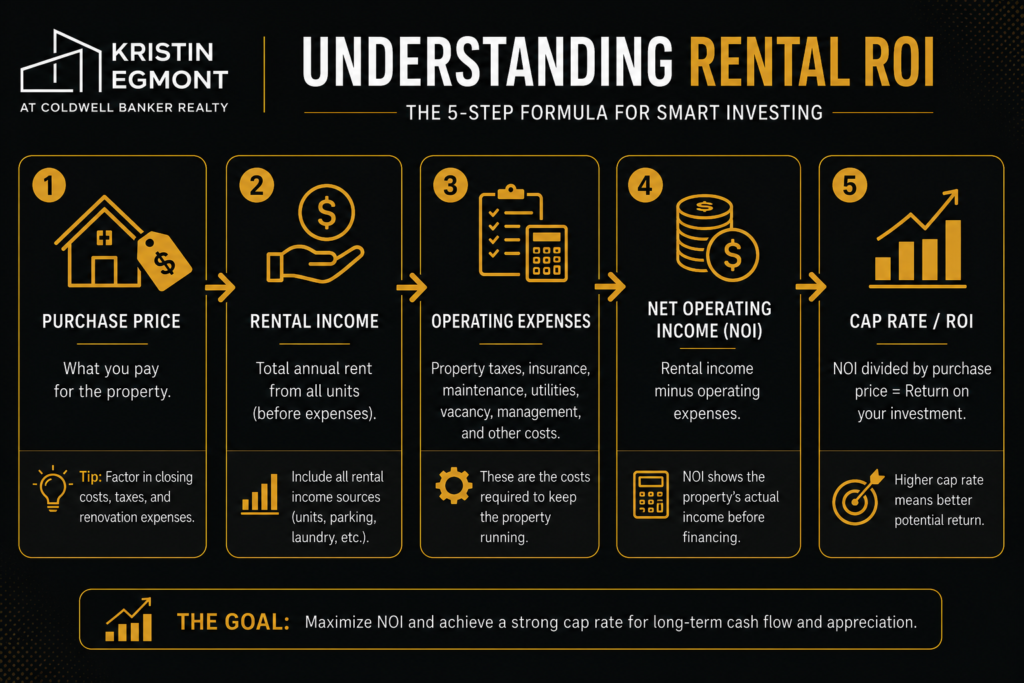
Before making an offer, anyone chasing rental income from Norwalk CT properties should be comfortable running a handful of core calculations. Purchase price alone tells you very little about how a building will actually perform. View our complete Norwalk investment property guide for the full numbers before you dive in.
Gross Rental Yield Explained
The gross yield is the annual rent divided by the purchase price, and it is a quick estimation of rental ROI Norwalk CT homebuyers can make without taking expenses into account. The house for sale for $850,000 yielding an income of $60,000 per year gives a gross yield of about 7%, but it drops considerably after deducting costs.
Net Operating Income (NOI) Basics
Net operating income represents gross rental income less operating costs, but not mortgage. It is the measure most used by lenders and real estate appraisers to measure the investment property income, and it is also used to calculate cap rate, making it very important that the operating cost side is done correctly.
Cash Flow vs Appreciation
Some buyers want monthly cash flow now. Others are fine with thinner margins today in exchange for equity growth later. Anyone planning to buy investment property Norwalk-wide should decide which outcome matters more before touring, since the two goals often point toward different buildings and different neighborhoods.
| Quick ROI Formula: Net Operating Income ÷ Purchase Price = Cap RateNet Operating Income ÷ Total Cash Invested = Cash-on-Cash Return |
Norwalk CT Cap Rates in 2026
Cap rate is the single most useful shorthand for comparing multi-family deals against each other, and it varies quite a bit by property class and location.
Average Cap Rates by Property Type
Across Connecticut, Class B multi-family cap rates have compressed to roughly 4.9%, Class C properties trade closer to 5.4%, and Class A assets sit near 4.7%. The range for the realistic Norwalk CT cap rate 2026 for a property in good condition with two- or three-family dwellings will be around the same 4.5% to 5.5% range, with the actual figure based largely on condition and the leasing agreement.
Factors That Affect Cap Rate
Maintenance issues, below-market rent, and temporary tenancies all cause cap rates to be higher, as they pose an additional risk for the purchaser. A buyer looking for an investment property in Norwalk should expect the building with older equipment and temporary tenancies to sell for a higher cap rate than its recently refurbished counterpart.
How Cap Rates Compare Across Fairfield County
The cap rate in Fairfield County is the lowest in Connecticut because of the prestige of the area and demand from commuters who have been pushed out of New York. This means that Connecticut rental property ROI in places such as Stamford, Norwalk, and Greenwich will generally appear more modest compared to properties in Hartford or New Haven, but investors make this compromise happily.
Also Read: Where to Buy in Fairfield County 2026: Top 10 Towns for Buyers & Investors
Financing Multi-Family Properties
Financing structure has as much impact on long-term returns as the purchase price itself, so it’s worth comparing options early rather than defaulting to whatever your first lender offers. Anyone looking to buy investment property Norwalk-wide should shop this step just as hard as they shop the listings.
Conventional Investment Property Loans
Conventional investment property financing CT lenders typically require 20% to 25% down for a non-owner-occupied multi-family purchase, along with stronger reserve requirements than an owner-occupant loan. Rates also tend to run slightly higher than owner-occupied rates, so shop multiple lenders before settling on terms.
FHA Loans for Owner-Occupied Duplexes
Buyers purchasing a duplex Norwalk CT for sale as a primary residence can use an FHA loan with as little as 3.5% down, provided they live in one of the units for at least a year. Fairfield County’s FHA loan limit for a single-family home sits at $977,500 in 2026, with higher limits available for two-, three-, and four-unit properties.
Down Payment Expectations
Down payment size for multi-family homes in Norwalk, CT varies widely depending on whether the buyer plans to occupy the property. Owner-occupants can often get in with 3.5% to 5% down through FHA or certain conventional programs, while pure investors should budget closer to 20% to 25% down plus several months of reserves.
| FHA vs Conventional, at a Glance: FHA (owner-occupied): as little as 3.5% down, must live in one unit for 12+ months. Conventional (investor): typically 20% to 25% down, higher reserve requirements Fairfield County FHA limit, single-family: $977,500 in 2026 |
Monthly Expenses Investors Should Budget For
Purchase price and mortgage payment are only part of the monthly picture for anyone evaluating rental income Norwalk CT properties. It pays to build a full expense worksheet before making an offer, not after.
Property Taxes
Norwalk’s median effective property tax rate is 2.39%, lower than the Connecticut state median of 3.05% but still well above the national median. Median annual Norwalk investment expenses tied to property tax alone run around $8,928, though the exact bill depends on assessed value, ZIP code, and whether the property sits within one of Norwalk’s local taxing districts.
Insurance Costs
The effective multi-family property insurance CT for Norwalk is 2.39%, which is less than the median of the State of Connecticut at 3.05%. However, even at 2.39%, this is well above the median rate nationwide. Norwalk’s median cost for investment-related property tax is approximately $8,928 annually, although the exact amount will depend on the property’s assessment and location in Norwalk.
Repairs, Maintenance & Vacancy Costs
An appropriate amount for rental property maintenance is from 5% to 10% annually of gross rental income, along with some allowance for vacancy between tenancy periods. Properties with old roofs, boilers, and electrical systems should have higher maintenance reserves until their systems are upgraded.
Best Norwalk Neighborhoods for Multi-Family Investments
Norwalk’s neighborhoods each offer a different mix of housing stock, price point, and commute access, which makes location research worth the time before you buy investment property Norwalk-wide.
South Norwalk (SoNo)
SoNo offers walkable restaurants, shopping, and its own Metro-North station, and its mix of older multi-family buildings alongside newer construction makes it a frequent stop for any SoNo investment property search. Waterfront proximity in parts of the neighborhood also supports premium pricing on updated buildings.
East Norwalk
East Norwalk pairs a residential feel with its own Metro-North stop and easy access to Exit 16 off I-95, which makes East Norwalk rentals attractive to commuters who want a shorter walk to the train. The neighborhood mixes two- and three-family homes, some with water views.
West Norwalk
West Norwalk leans more suburban, with larger lots and a quieter residential feel than the downtown areas. West Norwalk investment homes tend to trade at a premium per square foot relative to the citywide median, and true multi-family inventory here is thinner than in East Norwalk or SoNo.
Central Norwalk
Central Norwalk is in proximity to City Hall and the downtown area, featuring diverse housing stock and easy accessibility to Route 1 and Interstate 95. In terms of the Norwalk rental market, it is known for providing relatively affordable options in regard to the purchase of two- and three-family structures.
How to Evaluate a Multi-Family Property
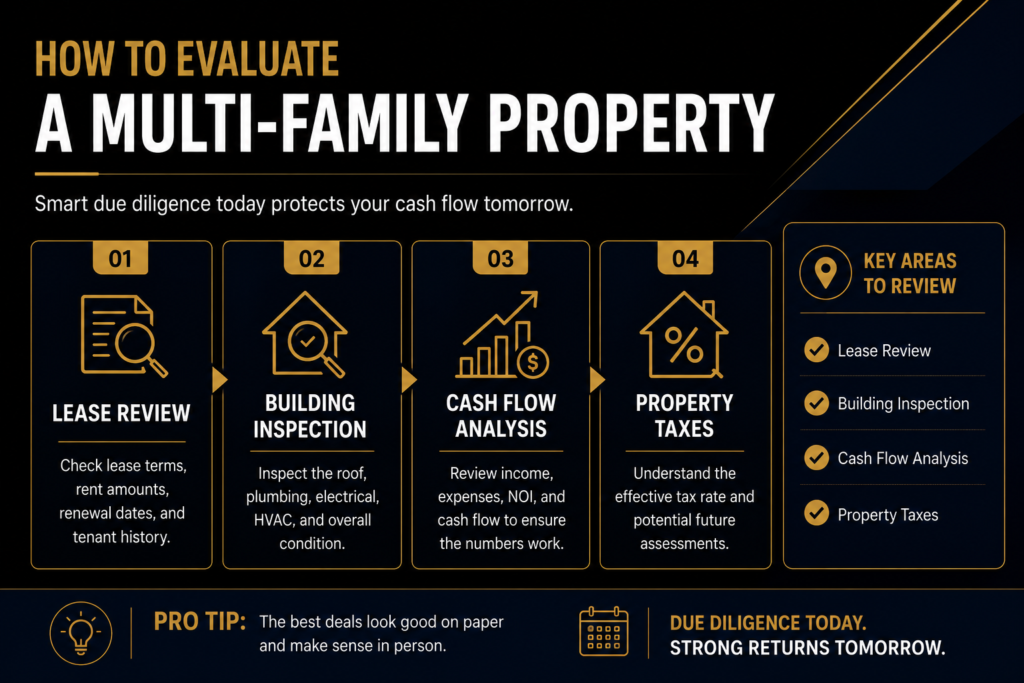
A thorough evaluation process protects buyers from overpaying for multi-family homes in Norwalk, CT that look good on the listing sheet but carry hidden problems underneath the surface.
Reviewing Existing Leases
Existing leases tell you far more about actual rental income in Norwalk CT than a seller’s advertised rent roll, since month-to-month tenants and below-market leases both affect financing and near-term cash flow in different ways. Always request copies of current leases, security deposit records, and rent payment history before making an offer.
Inspecting Building Condition
The multi-family inspection CT inspector must inspect each unit along with common mechanical areas such as the roof, foundation, electrical panel, and even common heating systems.
I suggest you walk each unit yourself before waiving the inspection contingency, because while a property may look fantastic from its pictures, there is a chance that behind just one closed door lies a whole decade of deferred maintenance.
Calculating Expected Cash Flow
Running the numbers through an investment property calculator before writing an offer helps confirm whether a building can realistically cash flow at the asking price, or whether it only pencils out at a lower number.
Get a personalized rental property investment analysis if you want help running these numbers against a specific listing.
Common Mistakes New Investors Make
Even experienced buyers fall into the same handful of traps the first time they buy investment property Norwalk-wide.
Buying Based Only on Purchase Price
Comparing buildings purely on price per unit is one of the most common investment mistakes CT first-time investors make, since it ignores differences in condition, lease terms, and neighborhood demand. Two buildings priced identically can produce very different returns once expenses are factored in.
Ignoring Maintenance Costs
Underestimation of expenses related to rental property will be another quick route for turning a potentially profitable investment into a marginal one. Old multi-family buildings may require roof repair, boiler repair, or electricity repair in the first few years after purchase, and these expenses must be anticipated and included in your budget right away.
Overestimating Rental Income
It is a mistake to believe that the rental income in Norwalk CT properties can be instantly increased to market level after purchasing it without considering the lease agreements, time required for turnovers, and upgrades required to increase the rent. It is better to have a lower estimate of the rent at the offer stage.
Is a Multi-Family Property in Norwalk a Smart Investment in 2026?
Buying multi-family homes in Norwalk, CT buyers want more than picking the lowest price. The right building affects your monthly cash flow, your financing options, and how much work sits behind the walls once you own it. Running the numbers in this guide gives you a real way to compare properties instead of guessing based on a good rent roll. Compare several listings before making an offer.
When you’re ready to move forward, set up a meeting with Kristin Egmont and explore investment properties in Norwalk so that you make your next move with a plan instead of speculation.
FAQs
Are multi-family homes in Norwalk, CT a good investment?
With prices ranging from $699,000 to $2,000,000 and listings averaging 51 days on market, multi-family homes in Norwalk CT remain a strong income option for buyers comfortable running the numbers before they offer.
What is the average cap rate for Norwalk investment properties in 2026?
4.5% to 5.5% is the typical Norwalk CT cap rate range in 2026 for a stabilized two- or three-family building, with condition and lease terms driving where a specific property lands within that range.
Can I buy a duplex in Norwalk CT using an FHA loan?
Yes. A duplex Norwalk CT for sale can be purchased with an FHA loan and as little as 3.5% down, as long as the buyer occupies one unit as a primary residence for at least a year.
How much rental income can a two-family home generate in Norwalk?
$3,500 to $5,500 a month is common for updated units. Rental income in CT two-family buildings varies by unit size and neighborhood, so treat that as a starting range, not a guarantee.
Which Norwalk neighborhoods offer the best rental ROI?
South Norwalk, East Norwalk, and Central Norwalk are generally the strongest starting points for buyers who buy investment property in Norwalk wide, each offering a different balance of price and tenant demand.
What expenses should I budget for when owning a multi-family property?
35% to 45% of gross rental income, combined. Property taxes, insurance costs, maintenance reserves, and vacancy costs form the basic cost considerations for rental property expenses.
Is buying a multi-family home better than a single-family rental?
For most investors, the answer would be the former. Multi-family homes in Norwalk CT are more profitable than single family rental properties as the revenue stream is shared among multiple units, making a vacant unit less problematic.
How do I calculate ROI on a Norwalk rental property?
Divide annual net operating income by total cash invested to estimate returns on rental income in Norwalk CT properties, then compare that figure against your target return before making an offer.
Are property taxes higher for multi-family homes in Norwalk?
Not automatically. Norwalk investment property taxes are based on assessed value and the applicable mill rate rather than property type alone, so a multi-family building isn’t taxed at a higher rate than a single-family home of similar value.
Should first-time investors buy a two-family home in Norwalk?
Often, yes. A 2-family home in Norwalk purchase, especially one bought through an FHA owner-occupant loan, is usually the most accessible entry point for first-time investors since it combines a lower down payment with built-in rental income.