

If you own property in Trumbull, a 2026 revaluation notice from Vision Government Solutions may already be in your mailbox, or it may be on its way. The notice matters because it shows the updated assessed value assigned to your property, which is one of the figures used to calculate your property tax bill.
A higher assessment does not automatically mean your taxes will rise by the same percentage. The final bill also depends on the Trumbull CT mill rate and how property values change across the town. This guide explains what to check on your revaluation notice, what the new assessment means for your taxes, and how the revaluation and mill rate work together.
Key Takeaways
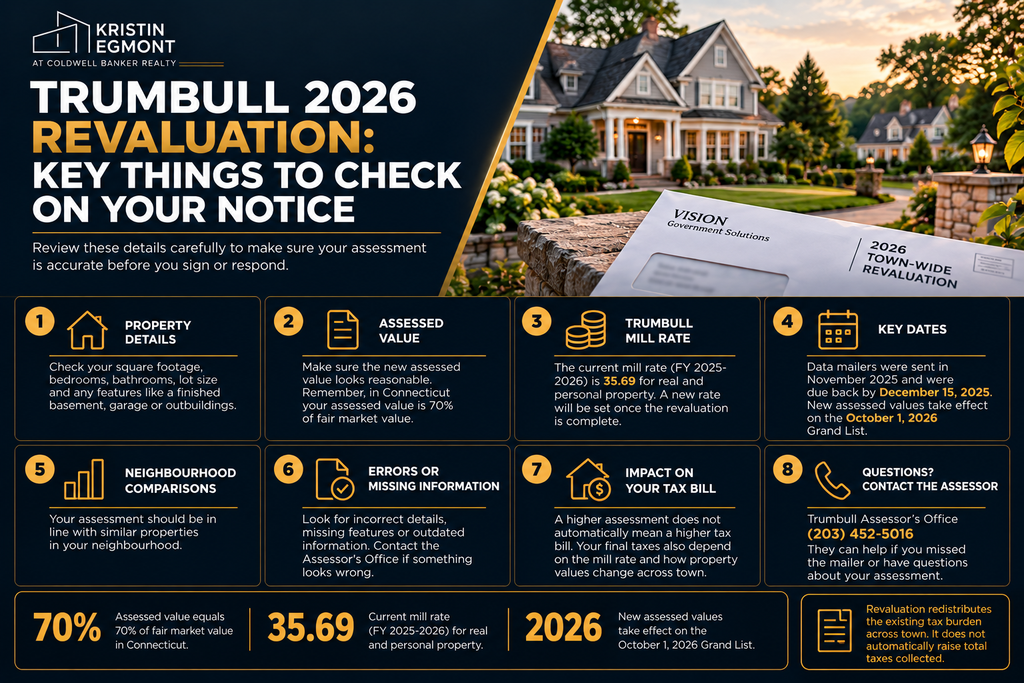
- Trumbull’s 2026 town-wide revaluation is required under state law on a five-year cycle. The state’s schedule originally called for 2025, but Trumbull was granted a one-year deferral to 2026.
- New assessed values take effect on the October 1, 2026 Grand List; tax bills reflecting them follow the next fiscal year.
- Your assessed value equals 70% of fair market value, not your home’s full market price.
- The current mill rate (FY 2025-2026) is 35.69 for real and personal property; a new rate gets set once the revaluation wraps.
- Revaluation redistributes the existing tax burden across town. It doesn’t automatically raise total taxes collected.
- Data mailers were due back by December 15, 2025. If you missed it, contact the Assessor’s Office.
- Check your mailer for errors in square footage, features, and lot details before signing anything.
Trumbull CT Revaluation 2026: What Homeowners Need to Know
Connecticut requires every town to revalue all property on a set cycle, and Trumbull’s right in the middle of that right now.
Why Is Trumbull Revaluing Properties in 2026?
State law, specifically Connecticut General Statutes §12-62, requires a revaluation at least every five years so assessments track actual market conditions instead of drifting further from reality with each passing year. Trumbull’s last Trumbull CT revaluation cycle wrapped up in 2021. The state originally penciled in 2025 for the next one, but Trumbull got a one-year deferral.
When Will the Trumbull Revaluation Take Effect?
New assessed values apply to the October 1, 2026 Grand List. Tax bills built around those new assessments typically show up the following fiscal year.
When Will Trumbull Homeowners Receive Their Revaluation Notices?
Data mailers went out to residential owners in mid-November 2025, due back by December 15, either mailed to Vision Government Solutions or emailed. If you missed that window, contact the Assessor’s Office, since an unreturned mailer typically means an interior inspection instead. Notices with your actual new assessed value come later, once the town-wide work is done.
What Is the Trumbull CT Assessor Responsible For?
The Assessor’s Office is the department actually running this process. Knowing what they do explains why certain details on your mailer matter more than they look like they should.
How the Assessor Determines Property Value
The Trumbull CT assessor values all taxable real property at fair market value. What a property would sell for on the open market, with no pressure on either side. For this cycle, that work is happening jointly with Vision Government Solutions, combining data collection, inspections, and recent local sales analysis.
The 70% Assessment Rule in Trumbull, CT
Your assessed value isn’t your market value. Connecticut sets it at 70% of fair market value as of the revaluation date, and that’s the number that actually gets multiplied against the mill rate to produce your Trumbull, CT property tax.
What Property Information Can Affect Your Assessment?
Living area, bedroom and bathroom count, finished basement or attic space, garages, outbuildings, lot characteristics. All of it feeds into your valuation. If the town’s records have your square footage wrong, or list a feature you don’t have, that error rides straight into your new assessment unless you catch it.
Trumbull CT Mill Rate vs. Your Property Assessment
Assessment and mill rate are two separate numbers doing two separate jobs, and mixing them up is the single most common mistake I hear from homeowners.
What Is a Mill Rate in Connecticut?
A mill rate is the tax owed per $1,000 of assessed value. Each Connecticut town sets its own rate annually based on its budget, and applies it uniformly across every property in town.
What Is Trumbull’s Current Mill Rate?
For fiscal year 2025-2026, Trumbull’s Board of Finance set the Trumbull CT mill rate at 35.69 for real and personal property, with motor vehicles taxed separately at 32.46.
| Trumbull, CT Mill Rate (FY 2025-2026)Real and personal property: 35.69Motor vehicles: 32.46 |
Why the Current Mill Rate Should Not Be Confused With the Future Revaluation Rate
That 35.69 rate applies to the current grand list, built off the 2021 revaluation. Once 2026 values land on the October 1, 2026 grand list, the town sets a new rate for the fiscal year that follows, and since total assessed value across town is expected to climb, that new rate will very likely come in lower than 35.69.
How Trumbull CT Property Taxes Are Calculated
Once you separate assessment from mill rate, the math itself is simple.
The Simple Property Tax Formula
Divide your assessed value by 1,000, then multiply by the mill rate. That’s your Trumbull, CT property tax.
| Property Tax Formula(Assessed Value ÷ 1,000) × Mill Rate = Annual Property TaxExample: $350,000 assessed value ÷ 1,000 × 35.69 = $12,492 per year |
Read more: Understanding Connecticut Property Taxes: What Homebuyers Need to Know
Assessed Value vs. Fair Market Value
A $500,000 home on the open market carries an assessed value around $350,000, since assessment is 70% of market value, not the market value itself. People run their estimates on the wrong number more often than you’d think.
Why Your Final Tax Bill May Differ From a Simple Estimate
Supplemental motor vehicle taxes, exemptions, mid-year adjustments. Any of these can nudge your real bill off a basic formula calculation, so treat the formula as a close estimate, not gospel.
What to Check When Your Trumbull Revaluation Letter Arrives
This is the part homeowners actually want detail on, since a mistake here can follow a property for years. Here’s exactly what to go through line by line before you sign anything.
Check Your Property Address and Parcel Information
Make sure the address, parcel number, and lot details actually match your property. Clerical mismatches happen more than you’d expect on town records, and a wrong parcel number can send your correction to the wrong file entirely.
Review Land and Building Details
Lot size, year built, listed improvements. If you’ve added a shed, finished a porch, or made any structural change since your last inspection, don’t assume the town updated its records automatically. Check.
Check Living Area, Bedrooms, Bathrooms, and Finished Space
Square footage and room counts move your valuation directly. If you’ve finished a basement or added space since your last inspection, this is where to confirm it’s actually reflected. A few hundred square feet off can shift your estimated value more than people expect.
Review Garages, Outbuildings and Other Property Features
Sheds, detached garages, pools. A feature that’s listed but no longer exists, or one that’s missing entirely, skews your assessment either direction, so don’t write off something small like a shed as not worth flagging.
Check the Estimated Market Value and Assessed Value
Once your notice shows an actual valuation figure, check that the assessed value lines up with the 70% rule applied to the listed market value.
Compare the Valuation With Relevant Local Market Evidence
If you have a sense of what similar homes nearby have recently sold for, check your new valuation against that. I can pull relevant comparable sales for you if you want a second opinion before you sign anything.
Look for Errors, Omissions, or Outdated Information
Anything wrong on the mailer, note the correction directly on the form before you return it. Catching it now beats appealing an assessment after the fact.
Does a Higher Assessment Automatically Mean Higher Property Taxes?
This is the single most misunderstood part of any revaluation, and it deserves a direct answer.
How Revaluation Redistributes the Local Tax Burden
Revaluation doesn’t automatically raise the total tax revenue a town collects. It redistributes the existing burden based on updated values, and the town then sets a new mill rate to match its budget against the new total assessed value on the grand list.
Why Your Assessment Change May Differ From Your Neighbor’s
If your home’s value rose more than the town-wide average since 2021, your share of the tax burden could go up even with a lower mill rate. Rose less than average? Your bill could actually drop.
Why the Mill Rate and Assessment Must Be Considered Together
Your new assessed value alone tells you almost nothing about your future bill. You need the new Trumbull CT mill rate, set for the fiscal year after the revaluation, before you can estimate anything with confidence.
Read more: Connecticut Property Taxes: A Homebuyer’s Guide
How to Estimate Your Future Trumbull CT Property Tax Bill
Once both pieces are on the table, here’s how to build your own estimate.
Find Your Property’s Assessed Value
Use the assessed value on your official revaluation notice once it’s issued, not the market value estimate that may have shown up on your initial data mailer. Once new values post, you can also pull your property’s field card through the town’s online assessment database, which is the most reliable way to confirm the number before building anything on top of it.
Apply the Applicable Trumbull CT Mill Rate
Once the town sets the new rate for the fiscal year following the 2026 revaluation, plug it into the formula above. Until then, any estimate built on the current 35.69 rate is a placeholder, since a rate drop looks likely once total assessed value across town climbs.
Account for Any Applicable Charges or Adjustments
Motor vehicle tax runs on its own separate mill rate, so factor that in on its own. Check whether you qualify for exemptions; veterans and elderly homeowners often do, and expect supplemental bills or mid-year adjustments to nudge your total slightly off a basic estimate.
What If You Think Your Trumbull Assessment Is Wrong?
If you’ve reviewed everything and still think your assessment doesn’t reflect your property, there’s a formal process for that.
Review the Property Record First
Pull your property’s online field card through the town’s assessment database on the Vision Government Solutions site to see exactly what the town has on file: square footage, room counts, lot size, listed features. Know what you’re correcting before you call anyone.
Document Factual Errors and Supporting Information
Dated photos, a recent appraisal, comparable local sales. Documented, specific evidence carries far more weight in a review than “this just feels too high.”
Contact the Assessor and Follow the Official Review Process
Call the Trumbull CT assessor directly at (203) 452-5016 with specific questions, and follow the town’s official appeal process and deadlines if you decide to formally contest your assessment through the Board of Assessment Appeals. Hearings typically run in spring, so don’t wait until that window’s nearly closed.
How the 2026 Revaluation Could Affect Trumbull Home Buyers and Sellers
If you’re active in the Trumbull CT real estate market right now, this revaluation is worth factoring into your timeline either way.
What Buyers Should Check Before Purchasing a Trumbull Home
Ask whether a property’s current assessment reflects the 2021 revaluation or has already been updated. Build in the expectation that tax bills could shift once the new grand list takes effect. Looking at Trumbull CT property values across a few neighborhoods helps you gauge how the new revaluation might land relative to what you’re considering paying.
How Property Taxes Can Affect a Buyer’s Overall Budget
Property taxes are a recurring cost, same as your mortgage payment, and they belong in your monthly budget just as firmly. Get a realistic estimate rather than leaning on last year’s bill.
What Sellers Should Know Before Listing a Trumbull Home
If your assessed value is likely to shift meaningfully once the revaluation finalizes, that’s context worth having before you set a listing price or answer buyer questions about taxes. Checking recent activity in the Trumbull real estate market before you list gives you a clearer read on where buyer expectations currently sit.
Why Local Assessment and Market Knowledge Matters
Understanding the assessment side and the current market together tells you more than either one alone. That’s where local Trumbull CT real estate expertise actually earns its keep.
Trumbull CT Mill Rate vs. Other Connecticut Towns
Comparing Trumbull’s mill rate directly to a neighboring town’s can be misleading.
Why Mill Rates Should Not Be Compared Alone
A lower mill rate doesn’t automatically mean lower taxes, and a higher one doesn’t automatically mean higher taxes. Assessment practices and timing differ town by town, and that changes how a rate actually translates into a bill.
How Assessment Values Change the Meaning of a Mill Rate
Because assessed value gets calculated differently depending on when each town last revalued, Connecticut property taxes by town only make sense to compare by looking at the actual dollar amount owed on comparable properties, not the mill rate on its own.
Trumbull CT Property Taxes in 2027: What Homeowners Should Watch
This revaluation sets off a chain of dates worth keeping on your calendar.
The October 1, 2026 Grand List
New assessed values from this Trumbull CT revaluation 2026 cycle become official on the October 1, 2026 grand list, the town’s formal record of every taxable property value for that year.
When Taxes Based on the Revalued Grand List Become Due
Tax bills built on the new grand list typically arrive the following fiscal year, so when will Trumbull revaluation take effect on your actual bill is more likely a 2027-2028 story than an immediate one.
Why the Future Mill Rate Matters
Once total assessed value across town shifts, expect the Board of Finance to set a new Trumbull CT mill rate against that updated total. Watching for that announcement is the only real way to get an accurate read on your future bill.
Final Checklist Before You Sign or Return Anything
Before you sign anything and drop it back in the mail, run through this last pass. It only takes a few minutes, and it’s the difference between an accurate assessment and one you’re stuck living with until the next revaluation five years from now.
Verify the Property Facts
Address, parcel details, living space, listed features. Match them against your actual property. This single check catches most of the errors that end up affecting an assessment.
Review the Valuation Figures
Check that any estimated market value and assessed value shown line up with the state’s 70% rule. If the math doesn’t add up, flag it with the Assessor’s Office directly rather than hoping it sorts itself out.
Document Any Discrepancies
Write corrections directly on the mailer, and keep a copy for yourself. A dated copy makes following up much easier if your correction doesn’t seem to have landed.
Follow the Deadline and Instructions on the Official Notice
Return your mailer by the stated deadline to the correct address. Miss it, and you may end up needing an interior inspection instead. If you’re ever unsure where something goes, a quick call to the Assessor’s Office beats guessing.
Understanding the Trumbull CT Revaluation and Mill Rate
The 2026 revaluation changes how Trumbull property taxes are calculated, but a higher assessment doesn’t automatically mean higher taxes. Your tax bill depends on how your property’s value changed compared to the town average and the new mill rate set by the Board of Finance. Review your data mailer and correct any errors before returning it to ensure a fair assessment.
If you plan to buy or sell in Trumbull during this transition, feel free to reach out to discuss how it might affect your property, or browse Trumbull homes and local market trends online.
FAQs
It comes down to your assessed value (which is 70% of fair market value) times the current mill rate, divided by 1,000. That’s your Trumbull CT property tax, and the number will shift once the 2026 revaluation and the new mill rate are both in place.
Take your assessed value, divide by 1,000, and multiply by the mill rate. So if your home’s assessed at $350,000 under today’s 35.69 rate, you’re looking at roughly $12,492 a year.
The new numbers land on the October 1, 2026 grand list. Your actual tax bill won’t reflect them until the fiscal year after that.
The Trumbull CT assessor is the one putting a fair market value on every taxable property in town and keeping those records straight. Right now, that means working alongside Vision Government Solutions on data collection, inspections, and valuation modeling for the 2026 revaluation.
Your home gets valued at 70% of what it would fetch on the open market, based on its features and what similar homes nearby have actually sold for.
Not really, and this trips people up constantly. A revaluation just redistributes the existing tax burden across town; it doesn’t hand the town a bigger pot of money to collect. Whether your bill goes up or down depends on how your value moved relative to everyone else’s.
Your address, land and building details, living space, listed features, and the valuation figures themselves. If anything’s off, mark the correction right on the mailer, and it’s worth checking your number against recent sales nearby too.
Data mailers went out back in mid-November 2025, due December 15. Formal notices with your actual new value come later, once the town finishes the full valuation work.
State law requires it every five years, no exceptions. Trumbull was originally on the hook for 2025 but got a one-year deferral.
Plug your assessed value and the mill rate into the standard formula, but treat anything based on today’s 35.69 rate as a rough placeholder. The real number depends on the rate the town sets after the revaluation is done.
Call the Assessor’s Office directly at (203) 452-5016. That’s your best source for anything property-specific, whether it’s about your mailer or requesting a formal review.