

Selling a home for a good price doesn’t mean you keep all of that money. At closing, taxes, fees, commissions, and other costs reduce your final take-home amount. Understanding these closing costs helps Connecticut homeowners price their property realistically and plan ahead.
This guide breaks down typical seller closing costs, who pays them, and uses real examples to show how they affect your payout. Knowing what to expect prevents surprises on closing day.
Key Takeaways
- Connecticut sellers typically pay between 8% and 10% of the sale price in combined commission, taxes, and closing charges.
- The state conveyance tax is graduated. Higher-priced homes pay a bigger marginal rate above $800,000, then again above $2.5 million.
- Connecticut law requires an attorney at every closing, and seller attorney fees usually fall between $750 and $1,500 for a straightforward sale.
- Commission is negotiable, and it’s almost always the largest single deduction from a seller’s proceeds.
- Property tax prorations, utility adjustments, and mortgage payoff figures all shift depending on the exact closing date, so treat early estimates as rough numbers.
- A proper seller net sheet, put together before you list, beats a back-of-the-envelope percentage every time.
What Are Closing Costs for Sellers in Connecticut?
Seller closing costs Connecticut-wide fall into four rough buckets: transaction taxes, professional fees, loan payoffs, and prorated adjustments tied to the property itself. Some are fixed by state law and won’t move no matter who you hire. Others depend entirely on what you negotiate in the purchase agreement.
Why Your Sale Price Is Not the Same as Your Net Proceeds
A listing price gets all the attention, but it’s not the number that matters once the deal closes. Net proceeds are the sale price minus the mortgage payoff, commission, conveyance taxes, attorney fees, and whatever prorated charges or credits show up along the way.
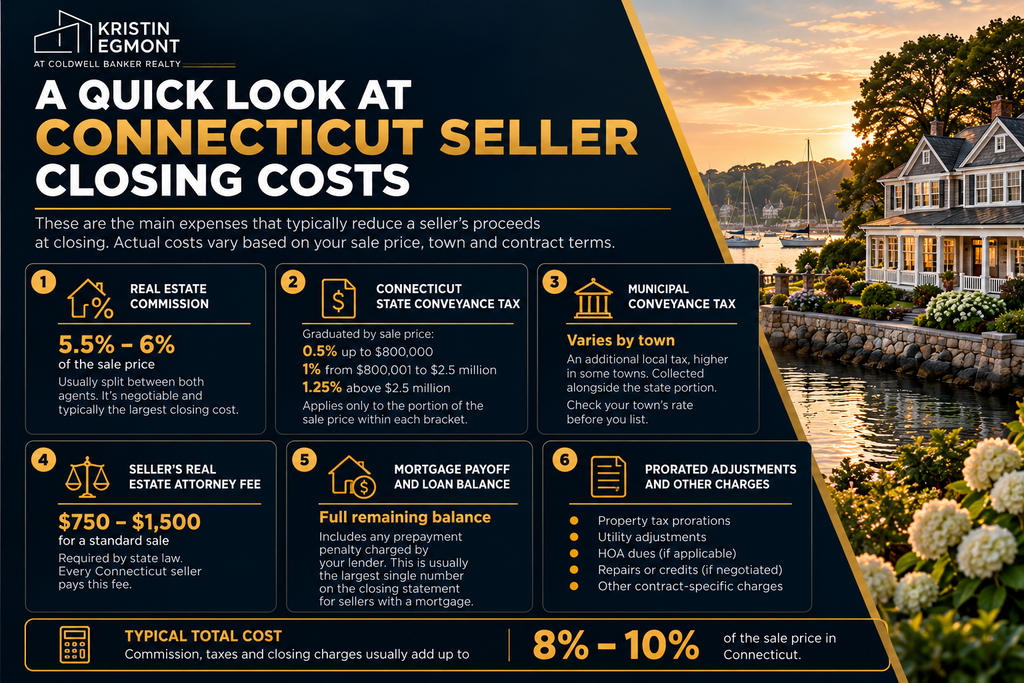
On a median-priced Connecticut home, total deductions commonly land between 8% and 10% of the sale price. Sell a $600,000 home, and you could reasonably see $48,000 to $60,000 in combined costs before you ever see a check.
| Two sellers can list identical homes at the identical price and still walk away with very different amounts. The gap almost always comes down to their mortgage balance and how much they negotiated away in concessions, not the sale price itself. |
Which Costs Are Typically Deducted at Closing?
The taxes, the attorney fee, and the mortgage payoff aren’t optional. They show up on every closing statement regardless of how the deal was negotiated, and there’s no version of a Connecticut sale where a seller skips them.
Commission falls into a gray zone. It’s technically negotiable, but in practice it’s deducted on nearly every sale because it’s set in the listing agreement months before the home ever hits the market.
Which Expenses Depend on Your Contract and Negotiations?
Repair credits, contributions toward a buyer’s closing costs, and occasionally a slice of the municipal conveyance tax are the items that move based on what actually gets written into the purchase agreement. None of them are guaranteed either way.
Two sellers with nearly identical homes on the same street can walk away with different net numbers purely because of how these points were negotiated during the offer stage.
Connecticut Seller Closing Costs
These are the charges that tend to show up on a Connecticut seller’s closing statement.
Real Estate Commission and Agent Compensation
Real estate commission usually averages 5.5% to 6% split between both agents, though it is negotiable. It is typically the largest closing cost for sellers.
Connecticut State Real Estate Conveyance Tax
Graduated by sale price, this tax is one of the few costs a seller can’t negotiate around, since it’s set by state statute rather than by contract terms. It’s explained in more detail below.
Municipal Real Estate Conveyance Tax
An added local tax, higher in select towns. It is collected alongside the state portion, appearing as a single charge. Confirm your town’s rate early to avoid surprises later.
Seller’s Real Estate Attorney Fee
Required by state law, generally $750 to $1,500 for a standard sale. Every Connecticut seller pays this fee regardless of how simple or complicated the closing turns out to be.
Mortgage Payoff and Outstanding Loan Balance
The full remaining balance, plus any prepayment penalty your lender charges. This is usually the largest single number on the closing statement for sellers who still carry a mortgage.
Mortgage Release and Lien-Related Charges
Recording fees tied to clearing your existing mortgage off the title. These are typically small compared to the payoff itself, but they’re still a required part of transferring clean title to the buyer.
Property Tax Prorations and Adjustments
A credit or debit based on Connecticut’s fiscal-year billing cycle. Depending on when your closing falls relative to the last tax bill, you could either owe money or receive a credit back.
Water, Sewer, and Municipal Charge Adjustments
Prorated to your closing date, similar to how property taxes are handled. If you’re on a municipal water or sewer system, this adjustment accounts for usage or fees between the last billing cycle and closing day.
Oil, Propane, and Other Fuel Adjustments
Reimbursement for any fuel left in the tank. If your home heats with oil or propane rather than natural gas, the buyer typically pays you back for whatever fuel remains at closing based on a fresh tank reading.
Repair Credits and Buyer Concessions
Whatever gets negotiated toward buyer closing costs or repairs. These aren’t required by law or custom, so the amount depends entirely on what came out of inspection negotiations and how the offer was structured.
Recording, Wire, Courier, and Administrative Charges
Smaller fixed fees from the attorney’s office or town clerk. Individually, these are minor, usually well under a few hundred dollars each, but they add up across a full closing statement.
Ask your attorney upfront whether these are included in their quoted flat fee or billed separately.
Other Costs That May Apply to Your Property
Multi-family properties, homes in an HOA, and estate or trust sales sometimes carry extra fees, like association payoff letters or probate-related filings, that don’t apply to a standard single-family sale. These can add both time and cost to the closing process.
If your property falls into one of these categories, flag these early so your attorney can build them into your timeline and budget.
Connecticut Real Estate Transfer Tax: What Sellers Need to Know
The Connecticut real estate transfer tax, officially the real estate conveyance tax, is paid by the seller and comes in two parts: a state tax and a municipal tax.
How Connecticut State Conveyance Tax Works
Under the current Connecticut conveyance tax rate schedule, the state rate steps up across three brackets rather than applying a single flat percentage to the whole sale price.
This means higher-value homes pay a bigger marginal rate only on the portion above each threshold, similar to how income tax brackets work.
State Tax Rate Up to $800,000
0.75% applies to the portion of the sale price up to $800,000. For most Connecticut homes, this single bracket covers the entire sale price, since the majority of transactions fall under that threshold.
State Tax on the Portion Between $800,000 and $2.5 Million
1.25% applies to the portion of the sale price between $800,000 and $2.5 million. Only the amount above the first threshold gets taxed at this higher rate, not the full sale price.
State Tax on the Portion Above $2.5 Million
2.25% applies to anything above $2.5 million. This top bracket is reserved for luxury sales, and it only affects the portion of the price that clears the $2.5 million mark.
Municipal Conveyance Tax and Town-Specific Differences
Most towns stick to a flat 0.25% municipal rate. Nineteen designated municipalities are allowed to charge up to 0.50% instead, which pushes the combined rate higher on sales in those towns.
Who Files Form OP-236 and When Is It Due?
Your attorney typically handles Form OP-236, the Connecticut conveyance tax form, at closing, filing it with the town clerk at the same time the deed is recorded.
Sellers don’t usually need to file anything themselves, since this is bundled into the attorney’s standard closing work.
Potential Exemptions and Special Circumstances
A handful of exemptions exist, including certain relocation-company transfers and specific property conditions, so ask early if you think one might apply to you. Waiting until closing week rarely leaves enough time to sort out an exemption claim properly.
Read more: How Connecticut Property Taxes Affect Your Home Sale Timeline
Who Pays Closing Costs in Connecticut?
This comes down to a mix of custom and contract language. Some costs almost always fall to the seller, some to the buyer, and a handful stay open to negotiation.
Costs Typically Paid by the Seller
Sellers typically cover the conveyance tax, their own attorney fee, commission, and the mortgage payoff. These are considered standard seller obligations in nearly every Connecticut transaction, regardless of how the rest of the deal is negotiated.
Costs Typically Paid by the Buyer
Buyers typically cover their attorney fee, lender fees, the appraisal, and usually both the owner’s and lender’s title insurance. These expenses relate directly to the buyer securing financing and protecting their new ownership interest.
Expenses That May Be Negotiated in the Purchase Agreement
Repair credits, a contribution toward the buyer’s closing costs, and occasionally a share of the municipal conveyance tax are fair game at the negotiating table. None of these are assigned by default to either party.
How Buyer Credits Can Change Seller Proceeds
A credit toward the buyer’s closing costs doesn’t touch the sale price on paper, but it comes straight out of what the seller actually walks away with, the same as a repair credit would.
Why the Contract Matters More Than General Closing-Cost Rules
The contract ends up mattering more than any general rule of thumb. Two sellers can hear the same advice about who usually pays for what and still end up with completely different outcomes.
How Commission Changes the Total Cost
Even half a percentage point shift in commission is thousands of dollars on a higher-value home.
On the $1 million example above, moving commission from 5.5% down to 5% alone would save a seller roughly $5,000.
| Commission is the one major cost on this list where a seller has real room to negotiate. Conveyance tax and attorney fees are fixed by law or by market norms, but commission structure is set by the listing agreement, which makes it worth a direct conversation before you sign. |
How the Mortgage Balance Changes Your Final Proceeds
Every example above is the total cost of selling, not the check you’ll actually receive. Subtract your remaining mortgage balance from that number, and the final proceeds can look very different from one seller to the next, even at the same sale price.
Two sellers of identical $800,000 homes could walk away with a $100,000 gap between them purely based on how much they still owed on their mortgage.
Why These Examples Are Illustrative Rather Than Quotes
Your town’s specific municipal rate, your negotiated commission, and your attorney’s fee structure all shift these numbers, so use them as a starting point for a conversation, not a final figure.
The only way to get an accurate number for your own sale is to run it against your actual town, price, and loan balance.
Read more: What to Expect When Selling Your Home in Connecticut
How to Calculate Your Net Proceeds Before Listing
Net proceeds come down to a fairly simple formula on paper: sale price minus costs and payoffs, but getting an accurate number means working through several pieces one at a time. Here’s where to start.
Start With Your Expected Sale Price
Base it on recent comparable sales nearby, not on what you originally paid or what similar homes listed for years ago.
An agent pulling current comps can help you land on a realistic starting number before you calculate anything else.
Subtract the Remaining Mortgage Balance
Include any prepayment penalty your lender might charge for paying off the loan early. This figure changes daily as interest accrues, so an old statement won’t be accurate.
Request a current payoff quote from your lender rather than relying on your last mortgage statement.
Estimate Commission and Negotiated Compensation
Use your listing agreement terms, since commission isn’t set by law and varies from one agreement to the next. This is usually the largest deduction on the whole worksheet.
If you haven’t signed a listing agreement yet, use the market average as a placeholder until the actual rate is finalized.
Account for State and Municipal Conveyance Taxes
Work out the state and municipal conveyance tax for your specific sale price and town, using the bracket breakdown covered earlier in this guide.
Since municipal rates vary, confirm your town’s exact percentage rather than assuming the standard 0.25%.
Add Attorney Fees and Other Closing Charges
Add the fixed fees on top of the attorney’s core rate, including recording, wire, and courier charges that tend to get bundled in near the bottom of the statement.
Include Property Tax and Utility Adjustments
Factor in prorated property tax and utility adjustments based on your likely closing date, since these can swing either as a credit or a debit.
Deduct Any Agreed Repairs or Seller Credits
Subtract any repairs or concessions you expect to offer, based on typical negotiations for homes similar to yours in your area.
Review the Estimated Seller Net Sheet
Pull it all together as a seller net sheet before you settle on a list price, or get help with your Connecticut home search at the same time. This single document turns every line item above into one clear number.
How to Prepare for Closing as a Connecticut Home Seller
Closing day tends to go smoothly for sellers who handle a few key tasks in the weeks beforehand, rather than leaving everything to the final days. Here’s where to start.
Request a Mortgage Payoff Statement
Get this early, so the number is current by closing day, since interest continues to accrue until the loan is actually paid off.
Review Your Estimated Seller Settlement Statement
Do this before the closing date arrives, rather than seeing the numbers for the first time at the closing table. Flagging a discrepancy a few days ahead of time gives your attorney room to correct it before signing.
Confirm Conveyance Tax Calculations
Check the figures with your attorney using your actual sale price, rather than relying on an early estimate from before negotiations wrapped up.
Ask About Attorney Fees and Additional Charges
Get attorney fees and any additional charges in writing well ahead of closing day, so there’s no ambiguity about what’s included. If your sale involves anything unusual, like a lien or an estate transfer, ask specifically how that affects the quoted fee.
Resolve Open Permits, Liens, or Title Issues Early
Handle these as early as you can, since they often take longer to clear than sellers expect once a title search turns them up.
Plan for Repairs, Credits, and Negotiated Expenses
Base this on the home inspection, since most concessions get negotiated in direct response to what the inspector finds.
Confirm the Closing Date and Property Tax Adjustments
Understand how your closing date shapes your property tax adjustment, since even a shift of a week or two can change whether you owe a credit or receive one.
Read more: A Connecticut Seller’s Checklist Before Closing Day
How a Local Connecticut Real Estate Expert Can Help Sellers
A local agent brings more to a sale than access to the MLS or Connecticut homes and real estate opportunities online. Their familiarity with the market shows up most clearly in the numbers they put in front of you before you list.
Estimating Your Likely Selling Expenses Before Listing
A good local agent estimates your likely selling costs before you list, using current commission norms, your town’s conveyance tax rate, and realistic attorney fee ranges.
Reviewing Pricing and Potential Net Proceeds
They check your pricing against realistic net proceeds rather than a rough percentage guess, factoring in your specific mortgage balance, likely closing costs, and how that stacks up if you find your next Connecticut property at the same time.
Understanding Local Market Conditions and Buyer Requests
They explain local market conditions shaping what buyers are asking for, including how aggressive concession requests tend to be in your particular town right now.
Coordinating With Attorneys and Other Closing Professionals
They coordinate with your attorney and the rest of the closing team, so nothing slips through the cracks between contract and closing day.
Helping You Compare Offers Beyond the Headline Price
Comparing offers on price alone can be deceiving once closing costs and requested concessions enter the picture. Working with someone who understands both sides of the transaction helps you work with a local Connecticut real estate professional who can weigh offers accurately.
Preparing for a Smoother Closing Process
Getting this groundwork done early is what gets you to a smoother closing and leaves you free to explore available homes in Connecticut, with fewer surprises in the final days before the sale.
Understand Your Connecticut Home Sale Proceeds Before Closing
Connecticut home sales involve multiple costs, including graduated conveyance taxes, town rates, and negotiated concessions. Reviewing these fees upfront gives you a much clearer picture of your actual net proceeds on closing day.
I work with sellers across Shelton, Norwalk, Darien, Easton, Monroe, Greenwich, and Stamford, and I walk every client through a full seller net sheet before we ever talk about a list price, so there are no surprises at the closing table.
Get a free seller net sheet before you list, or explore Connecticut properties if you’re planning your next move.
FAQs
Most Connecticut sellers pay 8% to 10% of the sale price in total closing costs, including commission, conveyance taxes, attorney fees, and prorated adjustments. Your exact percentage depends on the home’s price, local tax rates, and negotiated concessions.
Both sides pay their own set of costs. Sellers generally cover commission, conveyance tax, and their own attorney fee, while buyers handle lender fees, title insurance, and their own attorney. A few items, like repair credits, can shift between the two depending on how the purchase agreement is negotiated.
It’s a state and municipal tax paid by the seller when the deed is recorded at the town clerk’s office. The tax is graduated, meaning the rate increases on the portion of the sale price above certain thresholds, and it applies whether you’re selling a starter home or a much larger property.
Using the standard 0.75% state rate plus a typical 0.25% municipal rate, the combined conveyance tax on a $600,000 sale works out to roughly $6,000. That figure climbs if your town charges the higher 0.50% municipal rate instead of the standard rate.
The state applies 0.75% to the first $800,000 of the sale price and 1.25% to the remaining $200,000, for a state tax of $8,500. The municipal portion then gets added on top, based on your town’s rate, before you arrive at the full conveyance tax bill.
Yes. The municipal conveyance tax is a seller expense, paid alongside the state conveyance tax at the same time, and it’s collected by the town clerk when the deed is recorded.
Start with your expected sale price, then subtract your mortgage payoff, commission, conveyance taxes, attorney fees, prorated adjustments, and any concessions you’ve agreed to. Putting these into a full seller net sheet before you list gives you a far more reliable estimate than a rough percentage guess.
Not by default. Buyers generally cover their own lender fees, appraisal, and title insurance. A seller only ends up covering part of the buyer’s costs if it’s negotiated as a concession in the purchase agreement.
Yes. Repair credits, contributions toward the buyer’s closing costs, and even a share of the municipal conveyance tax can all be negotiated, and what ends up in the contract matters more than any general rule about who “usually” pays for what.
It affects your net proceeds more than your closing costs directly. The mortgage payoff, including any prepayment penalty, comes off the top of your sale price alongside commission, taxes, and fees, so a larger remaining balance means a smaller check at the end.
It’s a line-by-line estimate that starts with your expected sale price and subtracts every likely cost, including mortgage payoff, commission, taxes, attorney fees, prorations, and concessions, to show what you’d actually walk away with. Putting one together before you list beats guessing at a percentage.
No. Most towns charge a flat 0.25% rate, but nineteen designated municipalities are allowed to charge up to 0.50% instead, so it’s worth confirming your specific town’s rate before you list.
Your attorney typically files Form OP-236 on your behalf at closing, when the deed is recorded with the town clerk.
Your mortgage payoff statement, the estimated seller settlement statement, and any documentation tied to open permits, liens, or title issues are worth reviewing closely before closing day, along with confirming attorney fees in writing.
Before you settle on a list price. Working out your net proceeds early gives you a realistic number to weigh against your goals, rather than discovering the gap between sale price and take-home once offers start coming in.